TL;DR
USDT is a fiat-backed stablecoin issued by Tether on multiple blockchain networks. Payment risk is controlled when an invoice fixes both the token and network, fulfilment waits for a confirmed payment event, and withdrawals use approved destinations. Merchants should separate payer network fees, processing fees, and any later third-party conversion cost.
A valid USDT transfer can still fail to settle the intended invoice when the payer uses the wrong network, sends after expiry, underpays, or reuses an old address. The operating procedure matters as much as the asset.
USDT is a fiat-backed stablecoin issued by Tether. Businesses use it for blockchain payments, but the ticker does not identify a transfer route: Tron, Ethereum, and other networks maintain separate token contracts. A merchant must bind each invoice to one supported asset-network pair and wait for a confirmed payment state.
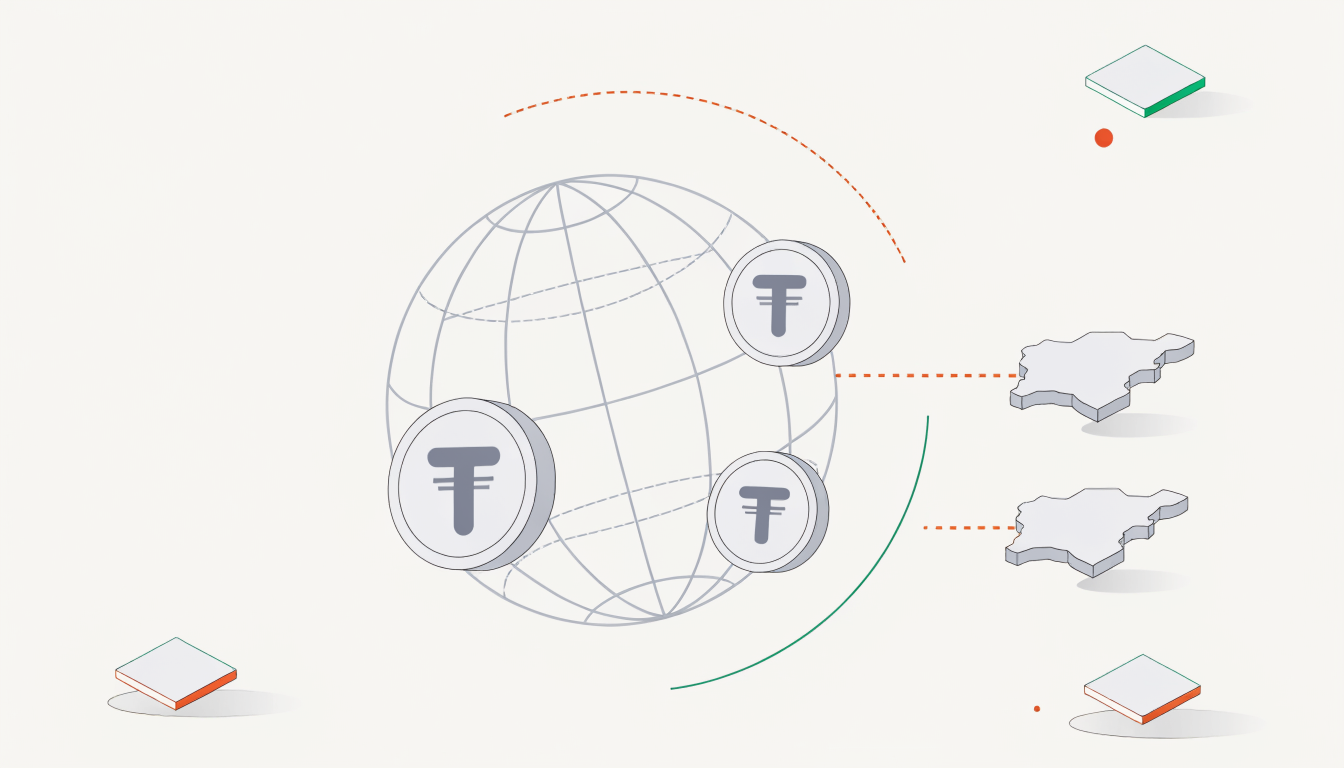
A transfer on one of those contracts never reaches an address on another, so what an invoice commits to is the pair — asset and network — rather than the ticker. Paymos accepts USDT on eleven of its mainnet networks, and the route a merchant leaves switched on is the one a customer can pay on.
What should be decided before USDT appears at checkout?
Start with an explicit route list. Each route is a token contract on a specific network, not a generic promise to accept anything labelled “USDT.” Decide which routes customers may choose, how long an invoice remains payable, what happens to late or partial transfers, and which payment state releases the order. Record the settlement asset expected by finance and the payout networks operations may use. This prevents product copy, checkout, fulfilment, and treasury procedures from making different assumptions about the same payment.
Use the current route matrix on the USDT payment page when configuring checkout. A copied network list in an internal procedure can drift from actual availability.
How should checkout present a USDT payment?
Checkout should bind four values: asset, network, amount, and expiry. Show the selected network beside the address and QR code, because a familiar address format does not prove that the payer selected the intended chain. Do not tell customers to “send USDT to this address” without the network. Do not promise a permanent gas amount; the payer's wallet calculates a live network fee under current conditions.
Create a new invoice for every payment attempt. Reusing an old address or amount makes reconciliation ambiguous and weakens expiry handling. If the customer changes networks, issue a route that the system actually supports rather than asking the customer to bridge funds during checkout.
When is a USDT invoice safe to fulfil?
A transaction hash proves that a transfer was broadcast, not that the invoice reached the processor's confirmed state. Networks differ in finality, and the appropriate confirmation policy can vary with the route, amount, and current conditions. Fulfil from the processor's payment state or verified webhook, not from a block explorer tab or a fixed timer maintained in the order service.
Design order handling to be idempotent. The same webhook may arrive more than once, and an underpayment or late payment needs a separate review path. The confirmation explainer covers finality concepts; this checklist is about the merchant decision tied to that result.
Where does merchant risk enter a USDT payment?
The main operational risks are route mismatch, premature fulfilment, ambiguous reconciliation, changed payout details, and an unverified refund address. None requires a failure of USDT itself. They appear when the order system treats a ticker as a complete payment instruction or gives one unverified signal authority to move an order or funds. Assign one control to each risk: an explicit asset-network route, a confirmed payment event, an idempotent order reference, an approved withdrawal destination, and authenticated refund approval.
Regulatory and accounting exposure is a separate business decision. If company policy does not allow USDT on the balance sheet, offer another supported settlement asset instead of relying on an undisclosed conversion.
Which USDT payment costs belong in the model?
Separate three cost layers. First, the payer's wallet pays the variable network fee for sending the transfer. Second, the processor charges its disclosed processing fee when the invoice settles. Third, any later exchange, broker, or cash-out provider may add its own conversion rate markup and withdrawal terms. Mixing them makes a low headline percentage look like the complete cost when it is not.
Paymos Standard pricing is 1.0% per settled invoice; Enterprise pricing is 0.3% on request. There is no setup fee, monthly platform fee, monthly minimum, reserve, or forced conversion rate markup. Paymos covers the network cost of acceptance and consolidation. Withdrawal can carry a disclosed network fee — subsidised, so it lands under the route's own cost — and a route minimum, so treasury should review the quote before approval.
How should treasury control USDT settlement?
Keep payment acceptance and treasury movement as separate permissions. The checkout team needs invoice state; it does not need authority to change payout destinations. Approve withdrawal addresses, verify the selected network, and require a second review when destination data changes. Paymos signs withdrawals on isolated infrastructure and sends them only to merchant-controlled, whitelisted addresses.
Reconcile the asset balance to settled invoices before withdrawing. A withdrawal does not silently convert USDT into fiat or another token. If conversion is needed, document the external venue, quoted rate, rate markup, and accounting treatment as a separate treasury action.
What is the safe refund procedure for USDT?
A refund is a new outbound blockchain transaction, not a reversal of the original payment. Never copy a destination from an unverified support message. Confirm the order owner, refund amount, asset, network, and destination through an authenticated workflow. If the customer paid from an exchange deposit or intermediary address, returning funds to the sending address may not credit their account.
Record the original invoice, approved destination, approver, transaction identifier, and resulting status. Use the same precision for partial refunds. The absence of card chargebacks removes one reversal path; it does not remove the need for a controlled merchant refund policy.
What should the operating checklist contain?
Before launch, run a small real payment on every enabled route and capture the complete state sequence: invoice created, transfer detected, payment confirmed, order fulfilled, balance updated, and withdrawal or refund reviewed. Test duplicate webhooks, underpayment, late payment, wrong-network instructions, and an unavailable payout destination. Operations should know which states are automatic and which enter manual review.
Use one invoice per attempt, one explicit asset-network route, fulfilment from a confirmed processor event, approved settlement destinations, and no hidden conversion assumption. Once those controls are documented, the merchant setup guide shows how to choose the Paymos integration surface.
| Stage | Merchant control | Failure prevented | |
|---|---|---|---|
| Checkout | Fix asset, network, amount, and expiry | Wrong-network and stale payments | |
| Detection | Match the transfer to one invoice | Duplicate or unmatched fulfilment | |
| Confirmation | Wait for the confirmed payment event | Premature fulfilment | |
| Withdrawal | Use approved destinations and the selected network | Misrouted settlement | |
| Refund | Create a reviewed outbound transaction | Refund-address fraud |
Frequently asked questions
What should a merchant check before accepting USDT?
Confirm the supported USDT network, invoice amount, expiry, confirmation state, refund process, and payout destination. Treat the asset and network as one payment route.
Who pays the network fee on a USDT payment?
The payer's wallet pays the variable network fee for sending USDT. By default, the merchant pays the disclosed Paymos processing fee, but a project can pass some or all of it to the payer; Paymos covers acceptance and consolidation network costs.
Can a merchant fulfil an order as soon as USDT appears on-chain?
No. A detected transfer is not necessarily the confirmed payment result. Fulfil only after the payment status or signed webhook reports the state required by the processor.
How should a merchant refund a USDT payment?
Verify the refund asset, network, amount, and destination before creating a new outbound transaction. A blockchain refund is not a reversal of the original payment.
When NOT to use USDT
- If the customer cannot send USDT on a network your checkout supports, offer another supported asset or network instead of asking them to improvise a bridge.
- If the payer's live network fee is disproportionate to a small invoice, offer a lower-cost supported route or combine the purchase into a larger payment.
- If your legal or accounting policy does not permit USDT exposure, accept another supported settlement asset rather than adding an undisclosed conversion step.
Sources
- 1. Tether tokens, supported protocols, and contract addresses (accessed 2026-08-02)
- 2. Ethereum proof-of-stake and finality (accessed 2026-08-02)
Last reviewed Aug 3, 2026