
TL;DR
A confirmation shows that a blockchain has accepted a transaction and continued building on its history. Waiting longer can reduce reorganization risk, but there is no universal safe count or settlement time. The right policy depends on the selected network, the payment amount, and current blockchain conditions. Paymos evaluates those variables for each payment instead of promising one fixed confirmation window for every invoice.
A blockchain confirmation means a transaction has entered the network's accepted history; finality is the stronger point at which that history is considered settled. A merchant should fulfil only when the processor's invoice state reaches the required outcome. There is no universal confirmation count or waiting time: the answer depends on the network, payment amount, and current blockchain conditions.
What does a confirmation prove?
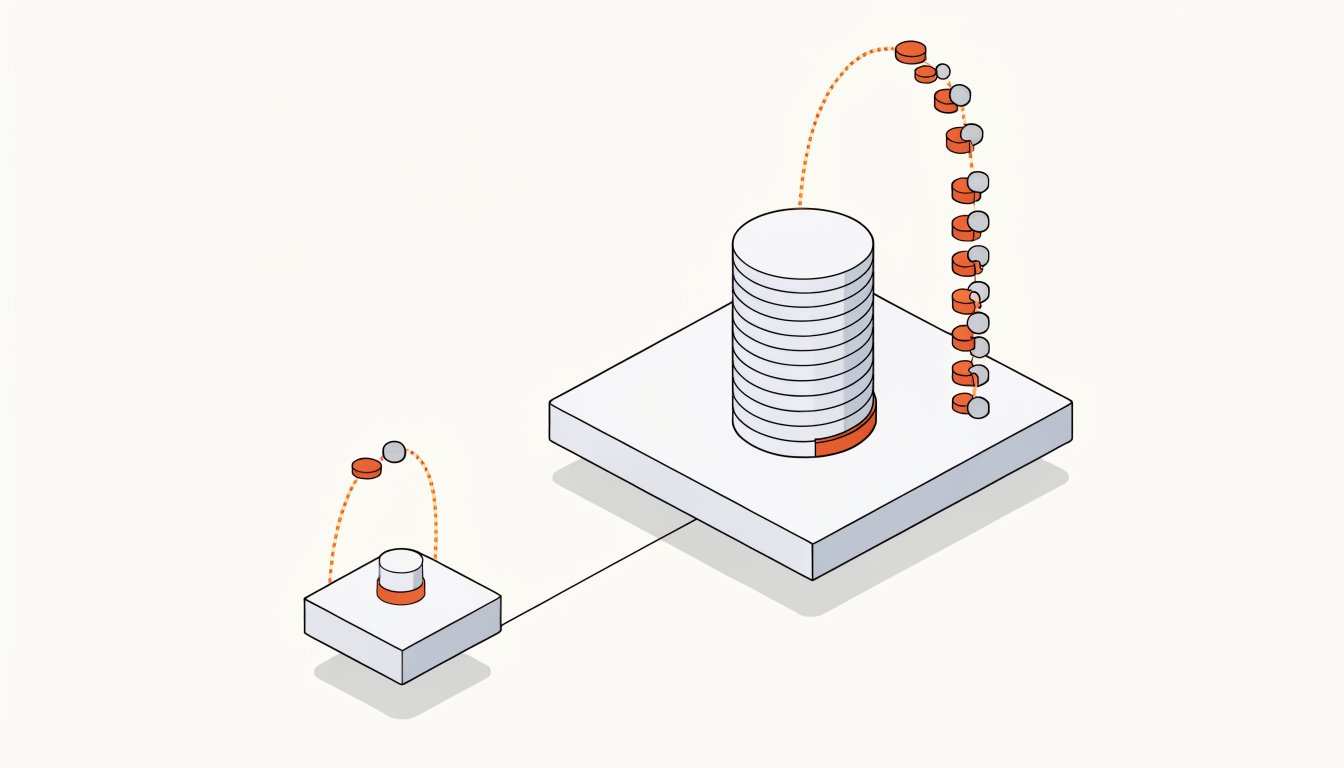
A confirmation shows that the network accepted a transaction into its history and continued to build or vote on that history. It does not prove that every blockchain uses the same route to settlement. Proof-of-work networks accumulate work, proof-of-stake networks collect validator attestations, and some consensus systems expose an explicit finality signal. In each case, the useful question for a merchant is whether the payment has reached the level of confidence required before goods, access, or services are released. Transaction inclusion is an early observation; finality is the stronger settlement outcome. Treating those concepts as identical can cause an order to be fulfilled before the network has provided the expected assurance.
Why does payment amount affect the policy?
The consequence of a reversed payment grows with the value of the order. A low-value purchase and a high-value invoice therefore do not present the same settlement exposure, even when both use the same token and network. A network-aware policy can require stronger finality as the amount at risk increases, while avoiding unnecessary delay where the exposure is lower. This does not produce one public threshold that remains correct forever. Network security, congestion, validator behaviour, and other live conditions can change. Paymos therefore bases confirmation policy on the network and payment amount, while confirmation time also varies with current blockchain conditions. Merchants should use the returned invoice state rather than recreate that decision from a static article.
How should a network-aware policy work?
The policy should start with the selected network's own settlement model. On a network where applications observe successive blocks, the processor evaluates how much chain history is appropriate for the payment. On a network that exposes finality directly, the processor can follow that signal instead of translating it into an arbitrary universal count. The payment amount then adjusts the required confidence within the applicable model, and current conditions can affect how long reaching that state takes. This is why two invoices for the same asset may not complete at the same moment. Paymos does not promise one fixed confirmation time for every payment; its policy depends on network, amount, and current blockchain conditions.
Why does finality differ between networks?
Blockchains use different consensus rules, validator structures, and ways of identifying the canonical history. Some applications infer increasing confidence as the chain extends. Others receive a distinct indication that the consensus layer considers a block final. These mechanisms should not be flattened into one cross-network table of counts or durations. Such a table would quickly become stale and could make a public network fact look like a permanent Paymos processing promise. Official network documentation explains the underlying mechanisms for Ethereum, TRON, BNB Chain, Polygon, and other supported rails. For an actual payment, the merchant should follow the invoice state produced for the selected network, amount, and current conditions.
How do gas fees relate to confirmations?
Gas or a network fee pays for submitting and executing a transaction. Confirmations and finality describe what happens after the network accepts that transaction into its history. A higher fee can improve inclusion priority on some congested networks, but it does not let a payment skip consensus or become final by itself. The customer therefore needs enough native gas asset to send the token, while the merchant still waits for the invoice state required for fulfilment. The gas fee guide explains who pays each network cost without turning fee estimates into fixed promises.
How can a transaction be checked while it confirms?
Copy the transaction hash into the block explorer for the network used by the customer. The explorer can show whether the transaction is pending, included, or followed by more chain history. Always verify the asset, network, destination, amount, and transaction hash; a transaction on the wrong network is not proof that the intended invoice was paid. An explorer is useful evidence for support, but a merchant should not fulfil from a customer screenshot or an isolated block count. The processor's invoice state remains the authoritative order signal.
What goes wrong with one fixed rule?
A fixed rule ignores information that materially changes settlement risk. If it is too weak for a particular network or amount, the business may release an order before the payment reaches an appropriate level of finality. If it is unnecessarily strict, the customer waits longer even when the selected network and payment amount support an earlier decision. The rule also ages badly because network conditions and consensus behaviour are not static. Copying a number from documentation into storefront code turns a live risk decision into a maintenance liability. The safer integration is to consume the processor's payment state and keep fulfilment idempotent, so repeated status delivery does not issue the order twice.
What should the integration do while waiting?
The checkout and order system should represent confirmation as a state, not as a countdown promise. After the customer sends the transaction, keep the order pending until the authoritative invoice state permits fulfilment. Show that the payment is being verified, and avoid wording that guarantees a particular completion time. The backend should match the update to the existing invoice, apply it idempotently, and record the result before releasing goods or access. If the payment remains pending longer than the customer expects, support should inspect the invoice and selected network rather than asking the customer to send a duplicate payment. Current blockchain conditions can delay an otherwise valid transaction.
What happens if recent chain history changes?
A chain reorganization can replace recent blockchain history with another valid history. If a payment was included only in the replaced portion, the processor must reassess the payment against the network's canonical state. The merchant-facing workflow does not need private implementation enums or statements about financial responsibility that are absent from current product facts. It needs a clear operational rule: release the order only after the authoritative invoice state reaches the required outcome, keep updates idempotent, and preserve enough order and transaction context for investigation. Confirmation policy reduces settlement risk; it does not remove product, fraud, fulfilment, or account-security risks that must be handled separately.
| State | What it proves | Merchant action | |
|---|---|---|---|
| Broadcast | A wallet submitted the transaction | Keep the order pending | |
| Included | The transaction appeared in accepted chain history | Wait for the required network-aware state | |
| Confirming | The network is building or voting on that history | Show verification in progress | |
| Final for fulfilment | The processor's policy reached the required confidence | Fulfil once and record the result |
Frequently asked questions
What is a confirmation in crypto?
A confirmation indicates that a transaction has been included in the blockchain and that the network has continued building on that history. The exact meaning varies with the network's consensus and finality model.
How many confirmations does USDT need?
There is no universal number for USDT. The required finality depends on the network carrying the token, the payment amount, and current blockchain conditions.
Does the same confirmation rule work on every network?
No. Networks expose settlement confidence differently. Some applications observe blocks built after a transaction, while others use an explicit finality signal from the network.
What is a chain reorganization?
A reorganization occurs when the blockchain replaces recent history with a competing valid history. A transaction in the replaced portion may no longer be part of the canonical chain.
Is finality the same as transaction inclusion?
No. Inclusion shows that a transaction appeared in a block. Finality is the stronger point at which the network considers that history settled under its consensus rules.
How should a business communicate confirmation time?
Show the current invoice state and avoid promising a universal duration. Completion varies with the network, payment amount, and live blockchain conditions.
Does a higher gas fee guarantee faster finality?
No. A higher network fee may affect how quickly a transaction is selected for inclusion on some networks, but it does not replace the network's confirmation or finality process.
How can a customer check a blockchain confirmation?
Open the network's block explorer and search for the transaction hash. The explorer can show inclusion and network progress, but the merchant should fulfil from the authoritative invoice state rather than a screenshot.
When NOT to use a merchant-defined fixed confirmation count
- If your payment processor already returns an authoritative invoice state, do not add a separate fixed block counter in the storefront.
- If the selected network exposes an explicit finality signal, follow the network-aware processor state instead of inventing an unrelated block rule.
- If an order must pass additional fraud, compliance, or fulfilment checks, confirmation alone should not trigger delivery before those checks finish.
Sources
- 1. Bitcoin: A Peer-to-Peer Electronic Cash System (accessed 2026-03-05)
- 2. Casper the Friendly Finality Gadget (accessed 2026-03-05)
- 3. TRON consensus and block confirmation (accessed 2026-03-05)
- 4. Proof-of-stake finality on Ethereum (accessed 2026-03-05)
- 5. Fermi hard fork on BNB Smart Chain (accessed 2026-07-29)
- 6. Heimdall v2 fast finality upgrade on Polygon (accessed 2026-06-25)
Last reviewed Aug 2, 2026