TL;DR
A crypto confirmation policy decides when an on-chain payment is ready to credit. Paymos reads two inputs: the network the payer chose and the invoice's dollar value. Each network carries its own confirmation depth for each amount band, so a small invoice clears shallower than a large one on the same chain. Those depths are configuration and can be quoted with their band. The minutes behind them belong to the chain, and merchant code should read the invoice state rather than a constant.
A depth copied into merchant code stops matching the day the configuration or the network changes. Fulfilment should follow the confirmed invoice state.
A crypto confirmation policy decides when a payment is ready to credit. Paymos reads two inputs: the network the payer chose and the invoice's dollar value. Every network carries its own confirmation depth for each amount band, so a small invoice clears shallower than a large one on the same chain. Those depths are configuration rather than an estimate, which is why this post can print them. What they are not is a clock — the minutes behind a count belong to the chain's block production, and an integration should release goods on the confirmed invoice state rather than on a timer.
What does a confirmation policy decide?
A confirmation policy turns a raw chain event into a payment outcome. On most networks that means counting blocks built on top of the block holding the payment. On a network that issues an explicit finality signal, the policy reads the signal instead. The merchant sees one thing either way — the invoice state — and never has to run the evaluation itself.
The policy exists because a recent chain observation is not a settled payment. A reorg — a chain reorganization — can replace recent blocks, so a wallet showing one confirmation has proved inclusion, not permanence. Depth buys probability. A protocol finality signal buys a stronger guarantee under that protocol's own rules. The integration boundary sits at the confirmed invoice state, not at a block explorer a support agent happens to be reading.
Why does the safe wait depend on the amount?
The amount is the value exposed if a recent block is displaced. Security is a property of the network; the size of the loss is a property of the invoice. A policy that ignores the second one has to pick a single wait for both, and neither answer is right: deep enough for a five-figure transfer makes a $20 order crawl, quick enough for the $20 order underprices the five-figure one.
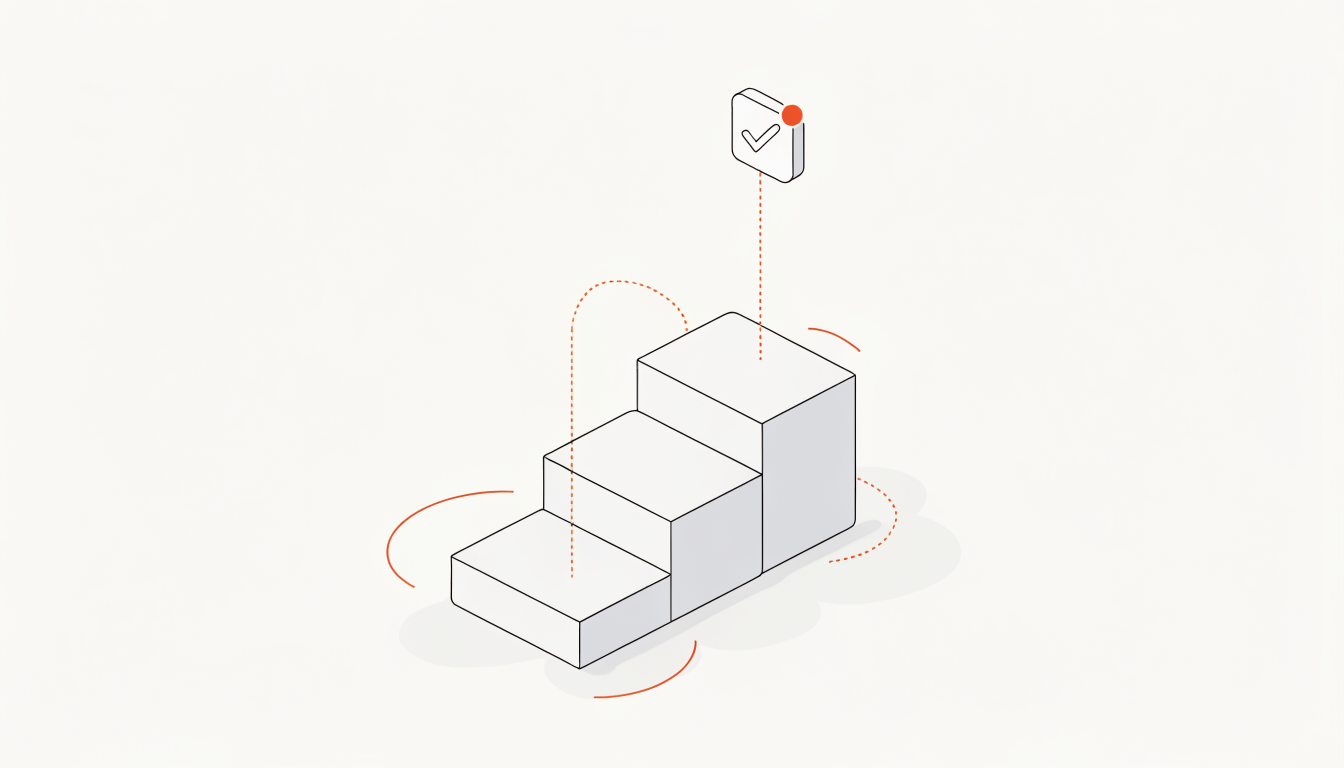
Banding the invoice's dollar value resolves that. The thresholds are $100, $1,000, and $10,000, and a tier applies up to and including its own threshold. The counts inside those bands differ per network, and some networks use fewer bands than others, because a block does not mean the same thing on every chain.
What does a tiered confirmation policy look like in practice?
Here is the whole rule for the networks where the bands do most of the work. An Ethereum invoice waits 2 confirmations at or below $100, 6 through $1,000, 12 through $10,000, then 32. Tron opens at 2, moves to 6, and caps at 19 above $1,000 — the point at which 19 of its 27 super representatives have solidified the block. Base and Optimism run 5 / 15 / 30 / 100 across the same thresholds. Arbitrum runs 40 / 120 / 240 / 800, which reads as extreme until you account for sub-second blocks: its four horizons land where Base's do.
Several chains need no bands. BSC and Polygon settle on their own finality signal. Solana is scanned at the finalized commitment and confirmed on discovery. TON asks for one block, because every masterchain block there arrives final.
Quoting one of those numbers alone is how the rule gets misstated. "Finality at 19 confirmations on Tron" is accurate above $1,000 and wrong beneath it. Carry the band with the count, or give the whole row. The confirmation guide covers why the same raw count does not represent equal safety on every network.
How long does a tier take in wall-clock terms?
A count becomes a duration only through the network's current block rate. Ethereum's shallow tier runs about 24 seconds at a normal cadence and its deepest a little over six minutes; Tron's shallowest sits near six seconds. Read every one of those as an approximation.
Blocks arrive more slowly when a network is congested, and the arithmetic drifts with them. That is the line between the two halves of this policy: the count is a setting, the time is a forecast. A checkout label, a support macro, or a contract clause that turns the forecast into a promise will be wrong on the first busy afternoon.
How does protocol finality affect confirmation policy?
A proof-of-stake network can issue finality rather than imply it. Ethereum organizes that through Casper FFG checkpoints, which settle history in epochs instead of one block at a time. Paymos still counts blocks on Ethereum — 2 through 32, depending on the band — so the amount stays part of the decision.
Where a chain's finality arrives fast and unconditional, the bands disappear entirely — which is why the four networks listed above run a single tier. Consensus answers there, directly, what a depth count can only make probable. Different models, one merchant-facing outcome: the invoice state.
Why must policy follow current network behavior?
Networks change how fast and how firmly they produce blocks. BSC's Fermi upgrade cut block times, and Polygon's Heimdall v2 shortened its path to finality. Each of those moves the wall-clock meaning of a count without touching the count.
That is the argument against freezing a number in merchant code. When a chain shifts, the depth configuration is ours to adjust; a constant in a merchant repository changes when somebody remembers to open a pull request. The tiers above are a snapshot of settings Paymos maintains, not a clause in an agreement.
When is a hard-coded confirmation count the right call?
Rarely, and never as a stand-in for the invoice state. Reading the table to understand the wait is fair use of it. Building an if around 12 confirmations is not: the constant leaves out the network the payer chose, the band the invoice landed in, and the next change to either.
The integration's job is narrower and outlives all of that. Persist the Paymos invoice identifier, verify the signature on status updates, and make fulfilment idempotent. An order should not leave because a timer expired, because a wallet displayed a block, or because a previous payment on another chain cleared quickly. Those observations help a support agent; they do not replace the confirmed outcome for the invoice in front of them.
How does Paymos apply the policy?
Paymos evaluates the network and the amount together, then reports the result. Smaller payments clear at fewer confirmations, larger ones wait for a stronger threshold, and the elapsed time follows whatever the chain is doing at that moment. The counts move only when Paymos moves them — which is exactly what separates them from the network fee, a price the chain sets and no page here quotes as a fixed amount.
The supported chains page lists the available payment routes. The confirmations explainer covers what a block count proves and where a protocol's own finality is the stronger signal.
| Dimension | Fixed count | Tiered policy | |
|---|---|---|---|
| Small ticket UX | One copied constant sets the wait | Shallowest depth the network offers | |
| Large transfer safety | Unchanged across payment amounts | Deeper tier as the invoice value rises | |
| Risk model | One wait for every amount | Wait scales with amount at risk | |
| On finality-tagged chains | Merchant interprets the network | Bands drop; the chain's signal decides | |
| Tuning surface | Merchant-maintained constant | Paymos configuration, no redeploy |
Frequently asked questions
What is a crypto confirmation policy?
A confirmation policy is the rule a payment gateway applies to decide when an on-chain payment is ready to credit. Paymos reads the network the payer selected and the invoice's dollar value, then applies the depth configured for that pair. The resulting invoice state is what the merchant integration should act on.
Why should confirmations scale with the payment amount?
The amount is the value exposed if a recent block is displaced. A $40 invoice and a $40,000 invoice on the same chain do not carry the same exposure, so they do not wait for the same depth. A single wait for both would either slow the small ticket for nothing or underprice the large one.
Can a merchant quote a Paymos confirmation depth?
Yes, as long as the amount band travels with the count. "Tron finalises at 19 confirmations" is true above $1,000 and wrong below it. Two further limits apply — the depths are settings Paymos can change, and the minutes derived from them are an approximation rather than a settlement guarantee.
How many confirmations does a large stablecoin payment need?
That depends on the network. Above $10,000 an Ethereum payment waits 32 confirmations and a Base payment 100 — different counts, similar wall-clock horizons, because a Base block is far shorter. Tron's deepest tier is 19 and applies above $1,000. Chains with native finality use no bands at all.
Should a merchant implement its own fixed confirmation count?
No. The depth belongs to the Paymos configuration and moves when that configuration moves, while a constant in merchant code holds its old value until someone redeploys. Reading the invoice state gives the same answer and stays correct after a change.
What's the difference between block-count and finality confirmations?
Block depth counts the blocks built on top of the payment's block. Finality is a stronger signal a consensus protocol issues under its own rules. Paymos counts depth where a chain offers nothing stronger and takes the chain's own finality where it does; either way the merchant reads one invoice state.
When NOT to use a hard-coded confirmation count
- If a contract needs a guaranteed settlement duration, a confirmation depth cannot supply one. The count is fixed; the minutes it takes are the chain's, and congestion stretches them.
- If merchant code has to mirror the depth table, reconsider the design. The configuration can change without a merchant deployment, and the invoice state already carries the result.
- If fulfilment cannot react to invoice state changes, add reliable state handling before automating delivery.
- If a workflow needs certainty before the confirmed outcome, use a separate business control rather than releasing on a block explorer view.
Sources
- 1. Bitcoin whitepaper: A Peer-to-Peer Electronic Cash System (Satoshi Nakamoto, 2008) — confirmation-depth probability model (accessed 2026-06-01)
- 2. Casper the Friendly Finality Gadget (Buterin, Griffith, 2017) — epoch finality under proof-of-stake (accessed 2026-06-01)
- 3. Ethereum consensus mechanisms: proof-of-stake finality and epochs (Ethereum Foundation) (accessed 2026-06-01)
- 4. TRON super-representatives and block solidification (TRON DAO documentation) (accessed 2026-06-01)
- 5. BNB Chain Fermi upgrade — fast finality announcement (accessed 2026-06-01)
Last reviewed Aug 21, 2026