TL;DR
Coinbase Commerce shut down on 31 March 2026. Coinbase Business is the successor, but it is a different product: it holds your funds rather than letting you hold them, and it is open to businesses in the United States and Singapore that complete business verification. For a merchant anywhere else, there is no migration path inside Coinbase — the replacement has to come from outside it. The decision that follows is not which brand to pick but which of two things you are replacing: the checkout, or the wallet.
Coinbase Commerce shut down on 31 March 2026. If you ran a checkout on it, the product that collected your payments no longer exists, and the thing Coinbase offers in its place is not the same thing under a new name. Understanding the difference is most of the decision.
What actually shut down?
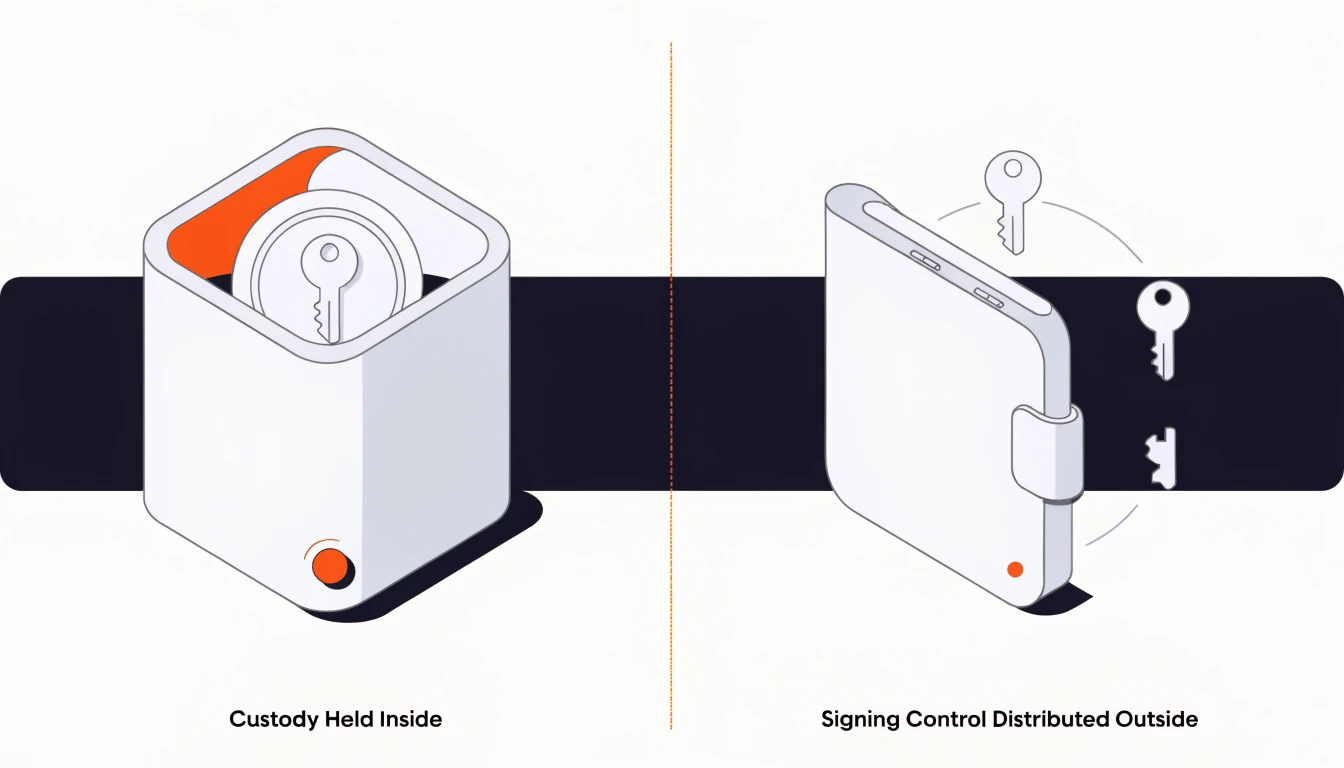
Commerce was a self-custodial product. Payments arrived at addresses derived from a seed phrase the merchant held, which meant Coinbase processed the payment without ever holding the money. That design is what made Commerce unusual, and it is also what made it available to merchants almost anywhere — a company that never takes custody of your funds has far less to verify about you before it will work with you.
Coinbase closed it and pointed merchants at Coinbase Business. Merchants were told to move funds off the platform and export their transaction history before the date, and merchants who had lost access to their seed phrase were told to contact support so they could recover the account and withdraw in time. If you are reading this after the fact and never did either, support is still the first call to make rather than the last.
Is Coinbase Business a migration path?
For most merchants, no — and it is worth being precise about why, because the answer is not that the successor is bad.
Coinbase Business is custodial. Coinbase holds the balance on your behalf, and that single change is what unlocks the features it advertises: a direct cash-out to a bank account, yield on an idle balance, and the operational tooling a finance team expects. Those are genuine advantages and a self-custodial product structurally cannot offer them.
The cost is who it can serve. The successor is open to businesses in the United States and Singapore that complete business verification, and if your company sits outside those two markets the migration path inside Coinbase does not exist for you. Coinbase's own transition page puts it plainly: Coinbase Business is not yet available in your region, and a merchant who wants to keep accepting crypto payments will need to move to an alternative provider.
Should you just wait for it to open in your country?
That is the question the closure actually leaves you with, and the answer is in what Coinbase did and did not commit to.
It said it is expanding to additional countries throughout 2026. It named no country and no date. An expansion with neither is not a schedule you can plan a payment route around — it is an intention, and your checkout has to work on Monday. Treat it the way you would treat any dependency with no delivery date: useful if it arrives, never load-bearing before it does.
There is also a quieter cost to waiting. Every month without a working checkout is not a pause, it is customers who tried to pay you and could not. If the expansion does reach your market later, moving to it then is the same size of job it is today — and you will do it with a live processor behind you instead of an outage.
Why does the replacement usually change who holds the keys?
Because self-custody and convenience pull in opposite directions, and most of the market resolved that tension the same way Coinbase did.
A self-custodial processor cannot cash out to your bank, cannot reverse an operator error, and cannot help you when the seed phrase is gone. It hands you the keys and steps back. A custodial processor can do all three because it holds the balance — and in exchange you are trusting an operator with your money, and that operator has to know who you are.
There is no clever third option that removes the trade-off. What varies between providers is where they land on it and how honestly they describe it. When you evaluate a replacement, the question worth asking first is not "is this custodial" but "if it is, what does the operator do to limit what a compromise would cost me, and will it say so plainly." We wrote the long version of this comparison in custodial vs non-custodial payment gateways.
What should you check before picking a replacement?
Five things decide whether a processor will actually work for you, and only the last one is about price.
Whether it accepts merchants in your market at all — this is where the Coinbase door closed, and it closes at other providers too. Which assets and networks it settles, because a processor that takes USDT on one chain when your customers hold it on another is a processor your customers cannot pay. What it needs from you before going live, since a provider that requires incorporation documents and a bank reference is a multi-week project rather than an afternoon. Whether it withdraws to a wallet you name, because a balance you cannot move is not your money in any practical sense. And only then the fee.
What happens to the addresses your old checkout handed out?
They stop being collectable, and this is the part that quietly costs merchants money during a migration.
A payment address issued by your old processor belonged to that processor's system, and once the account is gone, a payment sent to it is not going to be credited to an order you can see. Any invoice you issued that is still open, any payment link sitting in a customer's inbox, any QR code printed on a physical document — each one points somewhere that no longer resolves to you.
Before you switch, list every place an address or a payment link is still circulating. Reissue open invoices from the new processor and send customers the new link rather than assuming the old one degrades gracefully. It does not.
Which parts of your integration carry over?
More than you would expect, because the shape of the problem does not change between providers.
Your side of a crypto checkout is three things: you create an invoice for an amount, you send the customer somewhere to pay it, and you react when a notification tells you it was paid. Every processor implements those three, so the logic in your application — how an order maps to an invoice, what you do when payment confirms, how you handle an order that was never paid — survives the move. What you rewrite is the layer that talks to the provider: the endpoint you call, the shape of the request, and how you verify that an incoming notification is genuine rather than someone posting to your callback URL.
Budget for the verification step specifically. It is the part that is easy to skip and expensive to skip.
What does acceptance cost after the move?
At Paymos, 1.0% of a settled invoice on the Standard rate, and 0.3% on Enterprise by request. An invoice that was never paid, or that expired or was cancelled, carries no processing fee at all. There is no setup fee, no monthly platform fee, no monthly minimum, and no reserve held against your balance.
There is also no separate conversion fee, because nothing is converted. USDT arrives and stays USDT. That is worth checking wherever you land, since a provider that moves your balance into a different asset on the way in has a spread in that step whether or not it appears on the invoice as a fee.
Network fees work differently from both. The payer's wallet pays the network fee to send the payment, and Paymos covers the network cost of accepting it and consolidating it afterwards.
How does Paymos handle what Commerce merchants lost?
One of the two things, honestly, and it is worth naming the one it does not.
The market reach comes back. A merchant can start without submitting KYC or business documents, which is the same reason Commerce was available broadly, and Paymos settles across 13 mainnet networks — USDT on eleven of them, USDC on ten, alongside USD1, DAI and gold-backed XAUT. If the Coinbase door closed because of where your company is registered, that is the door this reopens.
Self-custody does not come back. Paymos is custodial and uses managed hot wallets, the same structural choice Coinbase Business made. What Paymos does about it: every invoice gets its own deterministic address, withdrawals are signed on isolated infrastructure, and they go only to destination addresses you have whitelisted. If self-custody was the reason you chose Commerce in the first place, a hosted processor is the wrong shape of answer and self-hosted software is the right one.
So which are you replacing, the checkout or the wallet?
That is the whole decision, and Commerce blurred it by being both.
If what you valued was the checkout — invoices, a payment page, a notification when money lands — a hosted processor replaces it in an afternoon, and the custody question is settled by picking an operator whose limits you can read. If what you valued was holding your own keys, no hosted processor replaces that, and the honest path is self-hosted software plus the operational work of running it.
Merchants lose time when they refuse to choose: they shop for a hosted product that also gives them custody, and there isn't one. Decide which half mattered, and the shortlist writes itself.
| Option | Who holds the funds | Who can sign up | What you accept | |
|---|---|---|---|---|
| Coinbase Commerce, until 31 March 2026 | The merchant | Merchants broadly | Several assets | |
| Coinbase Business | Coinbase | United States and Singapore, after verification | Stablecoins | |
| Self-hosted software | The merchant | Anyone who can run a server | Whatever the software supports | |
| A hosted processor | The processor | Depends on the processor | Its supported assets |
Frequently asked questions
When did Coinbase Commerce shut down?
On 31 March 2026. Coinbase directed merchants to move funds off the platform and export their transaction history before that date.
Is Coinbase Business the same product under a new name?
No. Commerce let the merchant hold the funds; Coinbase Business holds them for you, and it is open to businesses in the United States and Singapore that complete business verification.
What if I am not in the United States or Singapore?
There is no migration path for you inside Coinbase. The replacement is either self-hosted software you run yourself or a processor that accepts merchants in your market.
Do I have to accept stablecoins now instead of Bitcoin?
On most replacements, yes. Coinbase built its successor around stablecoins, and Paymos does not accept Bitcoin or any native coin as an invoice asset either — only contract-based tokens. If Bitcoin acceptance is the requirement, check it first, because it rules out a whole tier of providers.
Does changing processor break the links I already sent to customers?
Any payment link or address issued by the old processor stops being yours to collect on. Reissue open invoices from the new one rather than assuming an old link still routes anywhere useful.
When NOT to use a hosted processor
- If you must hold the keys yourself, no hosted processor fits by definition — that is what "hosted" means. Run self-hosted software instead and accept the operational load that comes with it.
- If your buyers pay in native coins like BTC or ETH, a stablecoin processor settles contract-based tokens and will not serve them.
- If you need money to arrive as fiat in a bank account, a stablecoin processor ends at the token. Pair it with an exchange or a service that does the conversion.
- If you are in the United States and wanted the Coinbase relationship specifically, Coinbase Business is open to you and the custody and cash-out features are real.
Sources
- 1. Coinbase Help — Transitioning from Coinbase Commerce to Coinbase Business (accessed 2026-08-16)
- 2. Paymos Pricing (accessed 2026-08-16)
Last reviewed Aug 16, 2026