TL;DR
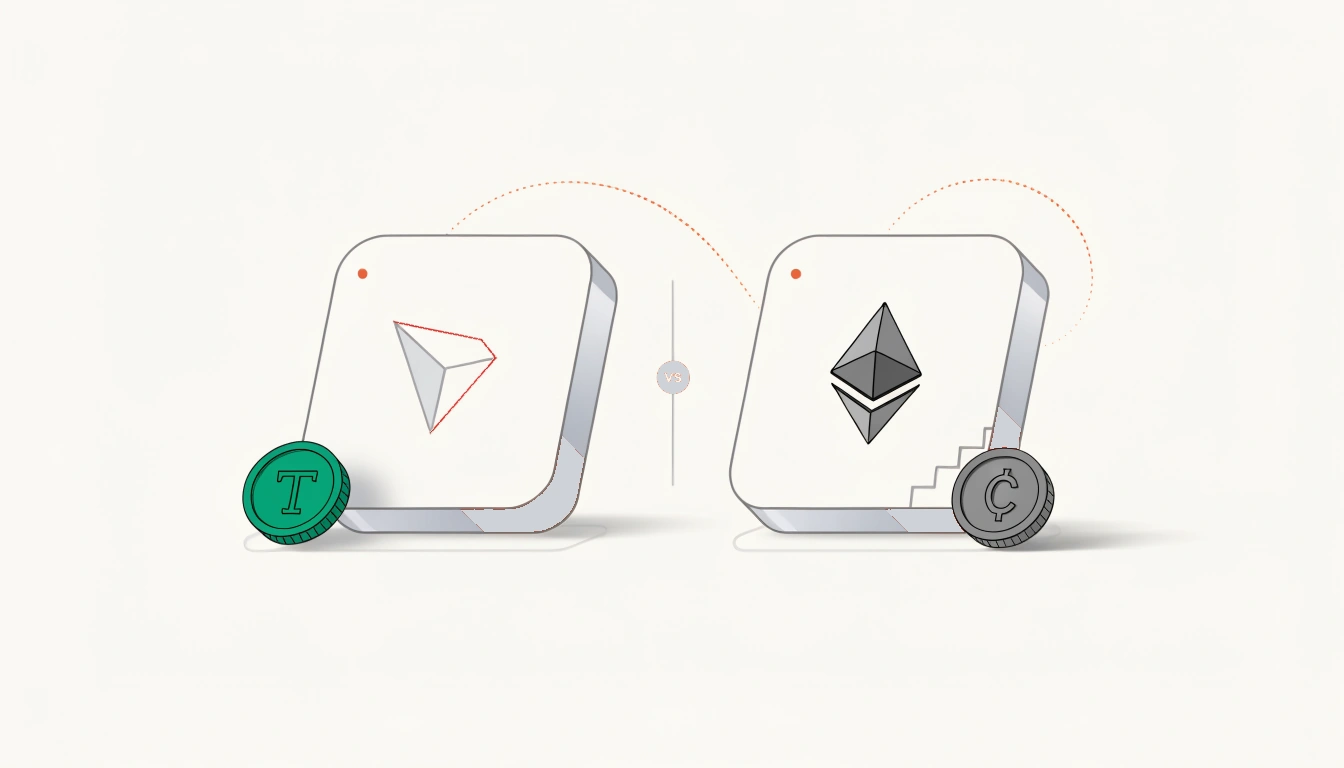
Tron and Ethereum calculate sender fees differently. Tron consumes energy and bandwidth available to the sending account, then burns TRX when those resources are insufficient. Ethereum prices execution through gas under EIP-1559. Neither network has a permanently lower price. Compare the live wallet quote, the payment amount, and the exact asset-and-network pair.
A stale fee estimate can make a sensible payment route look cheap or expensive when the payer's actual wallet would show the opposite.
Tron and Ethereum price a USDT transfer through different mechanisms. Tron uses account resources called energy and bandwidth, while Ethereum meters execution in gas under EIP-1559. A fixed dollar comparison ages quickly because the payer's account, the transaction, and current network conditions all affect the result. The reliable comparison is the live quote in the sending wallet for a supported asset-and-network pair.
How does Tron calculate the fee for a USDT transfer?
On Tron, a TRC20 transfer consumes energy for smart-contract execution and bandwidth for transaction data. The sending account can obtain resources through staking or delegation. If the account does not have enough resources, the network burns TRX to cover the missing amount under the current network parameters. This is why two people sending the same amount of USDT can see different wallet quotes. The difference comes from the sending accounts and current parameters, not from the merchant or the USDT balance itself. The payer should review the quote immediately before signing.
Why does receiving USDT not provide Tron resources?
Energy and bandwidth belong to an account's resource position; they are not attached to each USDT token. An exchange may fund or manage the resources for its own withdrawal, but those resources do not travel with the tokens to the recipient. If the recipient later sends the USDT onward, their wallet evaluates the resources available to that recipient account and may show a TRX burn. Merchant instructions should therefore avoid saying that a prior withdrawal has already paid for the next transfer. The relevant evidence is always the new sender's current wallet quote.
How does Ethereum calculate an ERC20 transfer fee?
On Ethereum L1, a USDT transfer calls a token contract and consumes gas. EIP-1559 defines a base fee that moves with block demand, while the sender can include a priority fee for inclusion. The wallet estimates the gas limit and combines it with the current fee parameters before the user signs. A price seen in an article, explorer screenshot, or earlier checkout can become stale. For a real payment, compare the wallet's current estimate with the invoice amount and make sure the asset and network match the route selected on the payment page.
Can a merchant call either network permanently cheaper?
No permanent winner follows from the mechanism alone. Tron can consume resources already available to one sender and burn TRX for another. Ethereum's base fee changes with demand, and other supported Ethereum-compatible routes have their own fee conditions. A useful checkout does not repeat a historical average as a promise. It offers supported asset-and-network pairs and lets the payer review the current quote. For small payments, the fee should be compared with the invoice amount because even a reasonable absolute fee can represent an unattractive percentage of a small purchase.
Which network can a Paymos customer use for each asset?
Paymos accepts USDT in Tron and Ethereum, but the two networks do not expose the same complete asset set. The current Paymos matrix accepts USDT, USDC, USD1, DAI, and gold-backed XAUT on Ethereum, while Tron acceptance is USDT. That makes the customer's existing balance an important decision factor. A payer who holds USDC or DAI cannot simply select Tron because its fee reputation sounds attractive. The payment page must show a supported pair, and the contract and network must match that selection rather than relying on a ticker alone.
How should a business compare confirmation speed?
The first visible block is not a universal promise that a payment is ready for fulfilment. Confirmation policy depends on the network, payment amount, and current blockchain conditions. Paymos sends webhook events for payment updates. The merchant should automate order fulfilment from the confirmed payment event instead of estimating readiness from a stopwatch or copying a fixed confirmation count from an article. This keeps the business rule stable even when networks differ in block production, reorganisation risk, or the strength of later finality.
Who pays the network fee and the Paymos fee?
The payer's wallet pays the network fee for the incoming transfer. Paymos processing is a separate charge: the Standard plan is 1.0% of the paid invoice, while Enterprise pricing of 0.3% is available on request. By default the merchant bears the processing fee, although a project can assign from 0% to 100% of it to the payer. Withdrawals have no separate processing fee. A selected asset-and-network route may instead include a disclosed network charge together with any applicable minimum amount. That charge is subsidised: the merchant pays less for the transfer than the route itself costs on-chain, and Tron is currently the most expensive payout route Paymos offers.
How should a merchant present Tron and Ethereum at checkout?
Present networks as supported routes, not as timeless price rankings. Show the customer only the asset-and-network pairs that Paymos accepts, make the selected network unmistakable, and tell the payer to check the live wallet quote before signing. If the quoted fee is a material share of the invoice, another supported route may be more suitable. After payment, rely on Paymos confirmation rather than a fixed time estimate. This approach avoids forced bridging, prevents wrong-network assumptions, and lets customers pay from balances they already hold while the merchant keeps one consistent operational flow.
| Factor | Tron | Ethereum | |
|---|---|---|---|
| Fee mechanism | Energy and bandwidth; TRX burn when resources are insufficient | Gas under EIP-1559 | |
| What the payer checks | Account resources and wallet quote | Gas estimate, base fee, priority fee, and wallet quote | |
| Paymos acceptance | USDT | USDT, USDC, USD1, DAI, and XAUT | |
| Permanent cheapest route | None; conditions vary | None; conditions vary |
Frequently asked questions
Is Tron always cheaper than Ethereum for USDT?
No. Tron and Ethereum use different fee mechanisms, and both change with account and network conditions. A Tron account may consume available or delegated resources, or burn TRX when resources are insufficient. Ethereum uses gas priced under EIP-1559. Compare the wallet's live quote.
Why can two Tron wallets show different fees?
Energy and bandwidth belong to the sending account. One account may have available or delegated resources while another must burn TRX for the missing resources. Receiving USDT from an exchange does not transfer the exchange's resource balance to the recipient.
What determines an Ethereum USDT transfer fee?
The wallet estimates the gas needed for the ERC20 contract call and applies the current EIP-1559 base fee plus a priority fee. Demand for block space changes, so the quote shown before signing is more useful than a historical dollar estimate.
Which network confirms a payment faster?
Confirmation depends on the network, payment amount, and current conditions. Paymos applies a confirmation policy appropriate to those factors. The merchant should act on the confirmed payment event rather than promise one fixed number of seconds for every transfer.
Which assets can Paymos accept on Tron and Ethereum?
Paymos accepts USDT on Tron. On Ethereum it accepts USDT, USDC, USD1, DAI, and gold-backed XAUT. Support is defined by the exact asset-and- network pair shown at checkout, not by a token ticker alone.
Sources
- 1. TRON resource model (accessed 2026-07-29)
- 2. EIP-1559: fee market change (accessed 2026-07-29)
- 3. Ethereum gas and fees overview (accessed 2026-07-29)
Last reviewed Jul 29, 2026