TL;DR
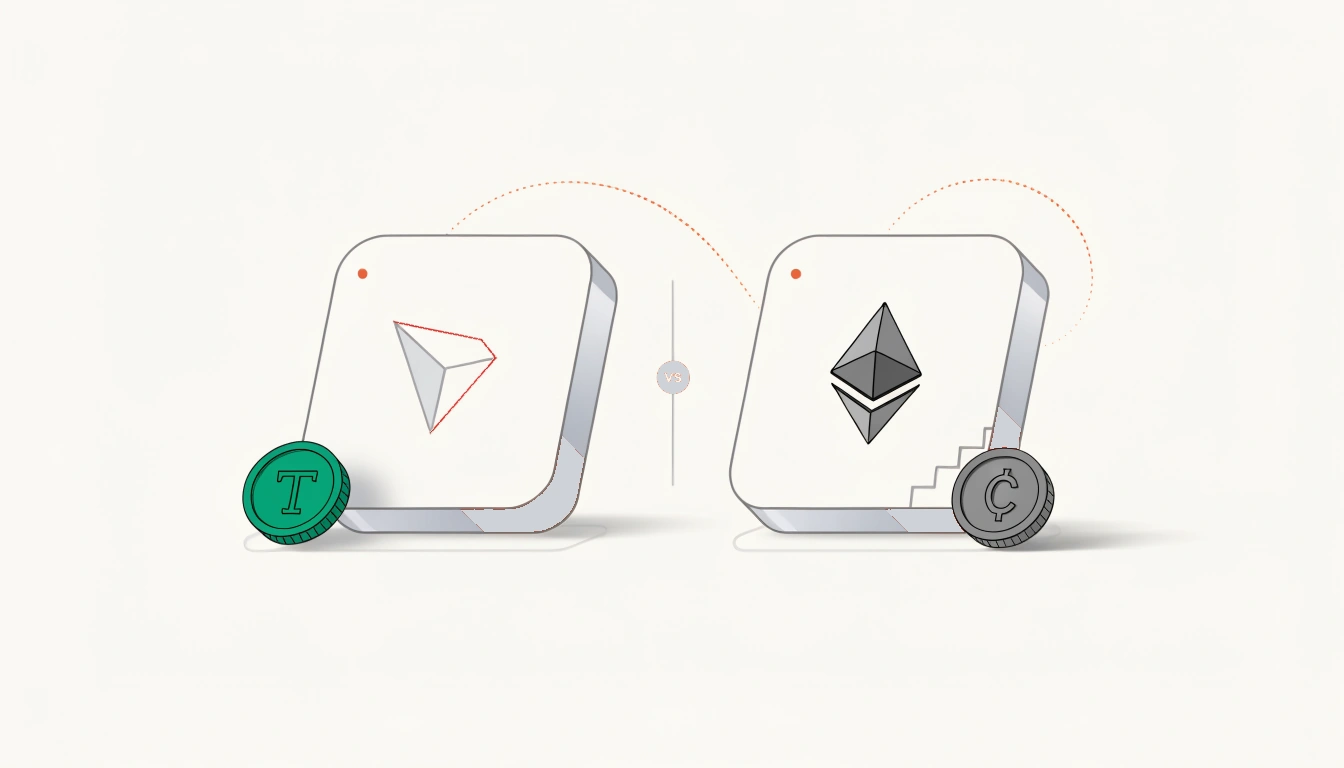
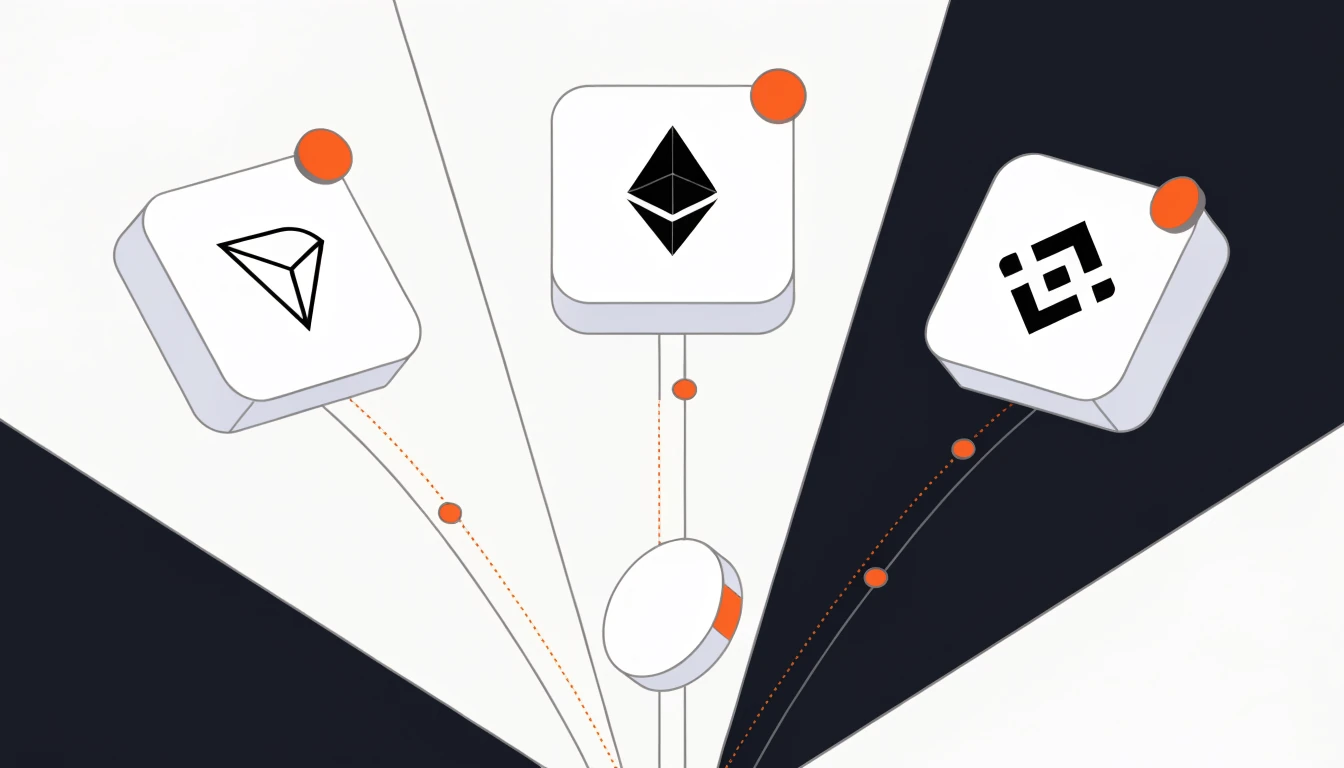
USDT TRC20 vs ERC20 vs BEP20 compares the same token across Tron, Ethereum, and BNB Smart Chain. Each version has a different contract, ledger, fee model, and confirmation path. Merchants should enable the networks their customers already hold and label every payment route with both token and chain.
USDT TRC20 vs ERC20 vs BEP20 compares the same stablecoin across Tron, Ethereum, and BNB Smart Chain. The routes do not share one ledger. Each network has its own USDT contract, fee model, wallet context, and confirmation path.
Payment matching has one strict rule. The asset and network must both match the invoice. “USDT” is not enough. The customer needs “USDT on Tron,” “USDT on Ethereum,” or “USDT on BNB Smart Chain.” Compare all available routes in the Paymos chain hub, then use the USDT acceptance guide to design checkout.
What are TRC20, ERC20, and BEP20?
Each standard defines a common token interface. It covers operations such as balances, transfers, approvals, and transfer events. ERC20 is the Ethereum interface formalized in EIP-20. TRC20 provides the corresponding smart-contract token standard on Tron. BEP20 adapts the ERC20 model for BNB Smart Chain.
The standards solve a software compatibility problem inside their own ecosystems. Wallets and applications know how to display a balance and submit a transfer because token contracts follow a common interface. They do not create compatibility across chains. An ERC20 token transfer updates Ethereum state, a TRC20 transfer updates Tron state, and a BEP20 transfer updates BNB Smart Chain state. Matching method names do not turn those three state machines into one network.
Why can the same token ticker exist on three networks?
A ticker is a label, not a global asset identifier. An issuer can deploy separate contracts for the same economic asset on multiple blockchains. USDT on Tron and USDT on Ethereum both target the same dollar value, yet each balance exists in a different contract and chain history.
Checkout must bind four details together. Token, network, amount, and destination define the payment route. A transfer can contain the correct ticker and amount but still fail the invoice if it arrives on the wrong ledger. The risk is highest between EVM networks because Ethereum and BNB Smart Chain addresses use the same visual format. A familiar-looking 0x address does not prove the selected network is correct.
Use explicit route labels everywhere. Apply them to checkout, confirmation messages, support replies, and refund instructions.
How does TRC20 work for payments?
TRC20 is the smart-contract token standard used on Tron. A transfer consumes Bandwidth and, for smart-contract execution, Energy. The wallet first uses resources available through its account or delegation. If those resources are insufficient, Tron burns TRX to cover the deficit at the network's current resource prices.
That distinction matters at checkout. A customer can hold enough USDT to cover the invoice and still lack enough resources or TRX to broadcast the payment. The wallet's live quote is the reliable cost because account resources and network parameters can change.
Paymos accepts USDT on Tron but does not accept USDC there. Tron is therefore a focused route in the Paymos asset matrix rather than a universal stablecoin network. Link customers who need the network detail to the Tron payment page.
How does ERC20 work for payments?
ERC20 is Ethereum's standard fungible-token interface. The sending wallet pays transaction gas in ETH, even when the transferred asset is USDT, USDC, USD1, DAI, or XAUT. Gas varies with network demand and the work performed by the token contract, so a fixed fee claim becomes stale quickly.
Ethereum carries the broadest Paymos asset set here. It includes USDT, USDC, USD1, DAI, and gold-backed XAUT. That makes ERC20 relevant when a merchant wants more than dollar stablecoins or serves customers whose assets already sit on Ethereum.
The merchant should not promise one fixed confirmation time. Paymos confirmation policy depends on the network and payment amount, and elapsed time also follows current blockchain conditions. Show the invoice state instead of converting a block count into a permanent checkout promise.
How does BEP20 work for payments?
BEP20 is the token standard on BNB Smart Chain. It derives from ERC20 and runs in an EVM-compatible environment, so wallets and contract interfaces look familiar to Ethereum users. The sending wallet pays transaction fees in BNB.
That familiarity creates the main operational risk. An Ethereum address and a BNB Smart Chain address can look identical, but the networks remain separate. A wallet set to Ethereum will not satisfy a BEP20 invoice, and a wallet set to BNB Smart Chain will not satisfy an ERC20 invoice.
Paymos accepts USDT and USDC on BNB Smart Chain. The route fits customers who already hold those assets on BSC. Do not push customers toward it based on a permanent “cheap network” label; let their wallet show the current fee and let their existing balance decide.
Which network is cheapest and fastest?
There is no permanent winner. The customer pays the inbound network fee, and the live amount depends on network conditions, wallet resources, and the token contract. Tron can be inexpensive for a wallet with allocated energy and materially different for a fresh wallet that must burn TRX. Ethereum gas varies with demand. BNB Smart Chain fees are paid in BNB and remain independent of Ethereum even though both networks use EVM tooling.
Speed also needs context. Block production is only one part of payment completion. A processor must decide when the transfer has reached an acceptable finality threshold, and Paymos adjusts that policy by network and payment amount. The correct checkout promise is a live status, not “always final in N seconds.”
The full cost model needs more detail. Read how crypto gas fees work.
How should a merchant choose among the three?
Start with customer holdings. Enable the networks on which buyers already keep the assets they want to spend. For Paymos, all three routes can accept USDT, while Ethereum and BNB Smart Chain can also accept USDC. Ethereum adds USD1, DAI, and XAUT; Tron does not.
Then evaluate checkout clarity. Every route should display the network name beside the asset, warn about the required native fee asset, and prevent the user from assuming that matching address formats mean matching chains. Support scripts should ask for both token and network before investigating a transfer.
Finally, evaluate treasury needs. Paymos records balances per asset rather than per deposit network. The merchant chooses from payout routes currently enabled for that asset, so customer network choice and merchant withdrawal route are related but not identical.
What happens after the customer pays?
Paymos observes each transfer on its selected blockchain. It applies the confirmation policy and credits the amount to that asset's merchant balance. The payer's wallet covers the inbound network fee. Paymos covers the network work required to accept and consolidate the payment within the processing model.
When the merchant withdraws, Paymos takes no withdrawal processing commission. The selected asset-and-network route can carry a network fee, subsidised below the route's own cost and disclosed before the transfer goes — and TRC20, ERC20 and BEP20 do not cost the same to send. Only routes enabled for that asset are offered, and the destination must be a whitelisted merchant-controlled address.
The network decision belongs at checkout. Balance management comes after settlement. The payer chooses a valid route for the transfer they can make. The merchant later chooses an available route for the balance they want to move.
| Factor | TRC20 | ERC20 | BEP20 | |
|---|---|---|---|---|
| Blockchain | Tron | Ethereum | BNB Smart Chain | |
| Native fee asset | TRX | ETH | BNB | |
| Paymos USDT support | Yes | Yes | Yes | |
| Paymos USDC support | No | Yes | Yes | |
| Address format | Tron address | EVM address | EVM address | |
| Main checkout risk | Insufficient resources and TRX | Variable gas | Wrong EVM network |
Frequently asked questions
What is the difference between TRC20, ERC20, and BEP20?
They are token standards on Tron, Ethereum, and BNB Smart Chain. They define similar transfer behavior but run on separate ledgers and use different native assets for transaction fees.
Can I send ERC20 USDT to a BEP20 invoice?
No. Similar-looking EVM addresses do not make Ethereum and BNB Smart Chain interchangeable. The token and network must both match the invoice.
Which network fee does the customer pay?
On Tron, the wallet consumes available Bandwidth and Energy, then burns TRX for any resource deficit. Ethereum uses ETH, and BNB Smart Chain uses BNB.
Does Paymos keep a separate merchant balance for every network?
No. Merchant balances are held per asset. Payments in the same asset can contribute to one balance, while withdrawals use only routes enabled for that asset.
When NOT to use a token network
- If the customer's wallet cannot cover Tron resource costs with available Bandwidth, Energy, or TRX, TRC20 adds friction. Offer another supported USDT route.
- If a payment must use a token unavailable on Ethereum, ERC20 cannot satisfy the request. Select a network where that asset is issued and supported.
- If the payer cannot verify the selected EVM network, BEP20 creates a wrong-network risk because its address can look identical to an Ethereum address.
Sources
- 1. ERC-20 Token Standard (EIP-20) (accessed 2026-07-29)
- 2. TRON token standards overview (accessed 2026-07-29)
- 3. TRON resource model (accessed 2026-07-29)
- 4. BEP-20: Tokens on BNB Smart Chain (accessed 2026-07-29)
- 5. BNB Smart Chain developer quick guide (accessed 2026-07-29)
Last reviewed Jul 29, 2026