
TL;DR
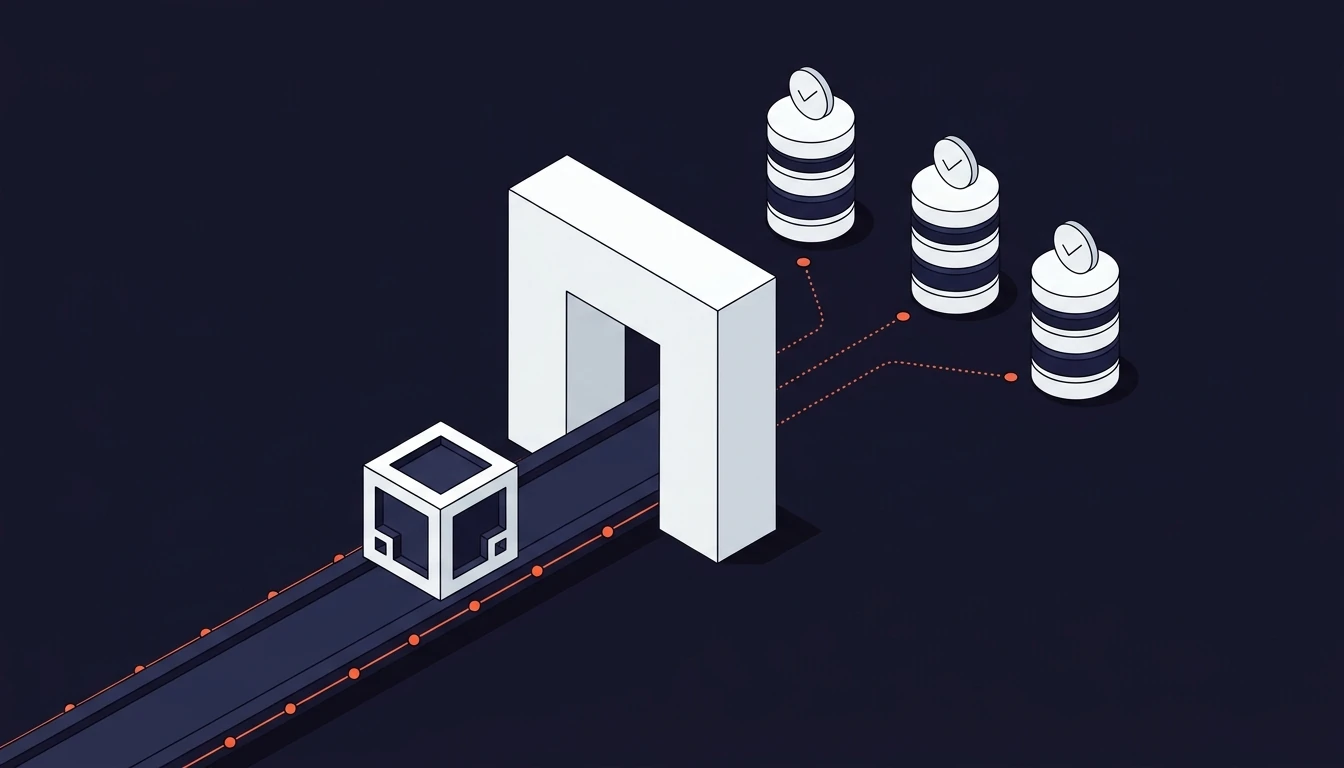
Automated mass payouts need a durable queue and idempotent retries. Each POST /v1/withdrawals creates a payout for one recipient, identified by a persisted external_order_id. Workers limit concurrent requests and retry with the same identifier and payload. The standard account limit of 30 requests per second is shared across API calls; it is not a completed-transfer rate. The Merchant Dashboard supports manual runs of up to 50 recipients in one asset and network, in Production only. Paymos charges 0% withdrawal commission and subsidises the disclosed network fee.
Disbursing cryptocurrency at volume is a core operational requirement for global platforms. Affiliate networks paying thousands of media buyers, iGaming operators executing instant player cashouts, Web3 protocols distributing contributor rewards, and crypto-native companies running international payroll all need to send hundreds or thousands of outbound transactions every hour.
Yet engineering teams frequently discover that scaling crypto payouts is fundamentally different from scaling traditional banking APIs. While an ACH or SEPA batch file simply transfers a CSV to a clearing house, blockchains enforce strict cryptographic consensus, sequential account nonces, mempool priority auctions, and irreversible settlement. A single unhandled error can jam an entire payout pipeline or broadcast duplicate transactions during a network timeout.
Building an enterprise-grade mass crypto payouts API requires purpose-built distributed architecture. Below is the blueprint for engineering high-throughput, enterprise batch withdrawal systems.
Why sequential payouts fail at scale: the nonce and mempool bottleneck
The most common mistake when integrating crypto withdrawals is writing a naive sequential loop: your backend reads 500 pending payouts from a database and calls eth_sendRawTransaction or tronWeb.trx.sendTransaction one by one in a synchronous loop. In production, this architecture breaks under load due to nonce serialization.
On Ethereum and EVM-compatible blockchains, every transaction originating from an account must include an incremental integer counter (the nonce):
$$\text{Transaction Sequence} = [T_{\text{nonce}=0}, T_{\text{nonce}=1}, T_{\text{nonce}=2}, \dots]$$
EVM transactions from one sender execute in nonce order. If transaction $T_4$ remains pending, later transactions from that sender can wait behind it. API request throughput and completed on-chain transfers are therefore different measures.
Attempting to resolve this by blindly bumping nonces in parallel leads to nonce collisions: two threads attempt to broadcast different transfers with the same nonce, resulting in RPC replacement transaction underpriced or nonce too low errors. To disburse thousands of transactions simultaneously, you must architect decoupled transaction pipelines.
Architecture 1: The Transactional Outbox pattern for financial resilience
The Transactional Outbox pattern commits each payout job and your internal balance change in the same database transaction. Persist its external_order_id there too, so a restarted worker can retry the same payout without creating a new one.
Key Principles of the Outbox Pipeline:
- Atomic State Deduction: The user's internal platform balance deduction and the creation of the payout record occur within the same local database transaction. Funds can never be deducted without creating a payout job.
- Idempotency Keys: Assign and persist one
external_order_idper payout before the first request. Reuse that identifier and the same payload on retries; generate a new identifier only for a new payout. - Decoupled Dispatch: Workers claim queued jobs asynchronously, for example using
FOR UPDATE SKIP LOCKED. Bound concurrency across workers and back off on errors, respectingRetry-Afteron HTTP429responses.
For complementary guidelines on handling callback integrity, consult our guide on payment webhook idempotency.
Architecture 2: Solving EVM nonce collisions with multi-vault key rotation
For a self-managed EVM payout service, multiple sender wallets are one way to separate nonce sequences. This architectural option does not specify Paymos wallet allocation or a completed-transfer rate:
$$\text{Vault Cluster} = {V_1, V_2, V_3, \dots, V_m}$$
Such a design needs to manage each sender's nonce sequence and pending queue:
- Independent Concurrency: Track pending transactions per sender instead of sharing an unchecked nonce counter across workers.
- Dispatch Decisions: Account for pending transactions when assigning new work; adding wallets does not complete an already delayed transaction.
- Funding: Account for the balance and network resources each sender needs before dispatch.
For an in-depth review of key isolation, review our architectural breakdown of hot wallet security.
Architecture 3: Multi-chain throughput across Tron TRC-20, EVM L2s, and TON
Platforms often have to pay recipients on more than one network, because recipients hold their funds on different networks and exchanges.
An enterprise payout API abstracts cross-chain complexities into a unified schema:
- TRON (USDT TRC-20): A supported USDT payout network. Energy affects transfer costs; see our TRON energy rental guide.
- Arbitrum, BSC & Polygon (USDT / USDC): Supported EVM payout networks. Base supports USDC only; choose an available route for the asset you hold.
- The Open Network (TON): A supported USDT payout network. Arrival depends on current network conditions.
The gateway normalizes multi-chain state transitions into unified webhook events, insulating the merchant backend from protocol-specific RPC differences. Payouts reach 11 mainnet networks (NEAR and Sui are deposit-only).
Pre-broadcast AML screening: stopping tainted payouts before network broadcast
One of the gravest operational risks in automated mass payouts is accidentally transferring funds to a sanctioned entity, darknet marketplace, or stolen asset address. If an automated hot wallet sends stablecoins to an OFAC-sanctioned address, your business risks severe regulatory consequences.
Enterprise payout gateways integrate automated Pre-Broadcast KYT (Know-Your-Transaction) gates:
- Address Risk Scoring: Before a withdrawal is routed, the recipient address is screened against these sources: TRM Labs, Binance AML, AMLBot, PureFi, and the screening provider's database.
- High-Risk Interception: If an address fails the screening check, the withdrawal is not sent. It transitions to
failed(withdrawal.failedwebhook), and the full reservedamount + feereturns to the merchant's available balance.
Screening can delay or prevent a payout; an accepted API request does not guarantee immediate broadcast.
Network fees: payout subsidies and TRON Energy
At high transaction volumes, network gas fees represent one of the largest operating expenses of a payout pipeline. Naive architectures that execute individual retail transactions bleed significant capital on network overhead.
Modern architectures optimize fees using two distinct strategies:
1. Zero Commission and Subsidised Payout Fees
Paymos charges 0% Paymos withdrawal commission. Merchants pay only the route's disclosed network fee, and every payout route is subsidised—the merchant pays less than the chain charges. Furthermore, if a payout fails or is cancelled, 100% of the reserved amount and network fee is returned to the available balance.
2. TRON Energy and the Disclosed Fee
Energy and other network resources affect TRON transfer costs. Use the disclosed fee for the selected payout route instead of assuming a fixed dollar cost per transfer. For fee information, review the Paymos pricing page.
Handling network edge cases: fee spikes, stuck transactions, and speed-ups
Public blockchains are dynamic environments subject to sudden volatility. A payout integration should account for these cases:
- Delayed Transactions: Track the existing withdrawal rather than submitting a new payout with a different identifier when completion takes longer than expected.
- Chain Reorganizations: As detailed in our analysis of blockchain reorgs, transactions can be orphaned. Handle
withdrawal.completion_rewound, which returns a completed withdrawal tosigned, and follow its subsequent status updates. - Request Failures: Persist jobs before dispatch and retry with the same
external_order_idand payload after a connection failure.
Developer REST API integration: dispatching high-throughput payouts via Paymos
Use the Paymos host-to-host REST API to create and track individual withdrawals from your own payout queue.
1. Submitting an Idempotent Payout via REST API
Your backend sends one authenticated POST /v1/withdrawals per recipient. Use a Payout (rk_) key and HMAC-SHA256 authentication. The header values below are placeholders: generate a signature for the exact request bytes and current Unix timestamp. Destination addresses normally need to be on your withdrawal whitelist.
POST /v1/withdrawals HTTP/1.1
Host: api.paymos.io
Authorization: HMAC-SHA256 rk_live_<key_id>:<base64_signature>
X-Request-Timestamp: <current_unix_seconds>
Content-Type: application/json

{
  "currency": "USDT",
  "network": "TRC20",
  "amount": "25.00",
  "destination_address": "TN3W4H6rK2ce4vX9YnFQHwKENnHjoxb3m9",
  "external_order_id": "payout_usr_101"
}
Creation returns HTTP 201 Created with status created; a retry with the same external_order_id returns HTTP 200 OK and the existing withdrawal. Amounts and fees below are illustrative, not a tariff:
{
  "withdrawal_id": "wdr_7K2M9P4Q8R1X5Z3A0bC2dE",
  "external_order_id": "payout_usr_101",
  "status": "created",
  "is_final": false,
  "is_test": false,
  "amount": "25.00",
  "fee": "0.50",
  "currency": "USDT",
  "network": "TRC20",
  "destination_address": "TN3W4H6rK2ce4vX9YnFQHwKENnHjoxb3m9",
  "created_at": 1739277600
}
The standard 30 requests per second account quota is shared across API calls. Limit worker concurrency, back off on retries and respect Retry-After on HTTP 429; this quota does not guarantee a completed-transfer rate. The Merchant Dashboard also supports manual runs of up to 50 recipients in one asset and network, in Production only.
2. Processing Async Completion Webhooks
On completion, Paymos sends withdrawal.completed in the versioned webhook envelope. Its data contains the withdrawal snapshot, with status, is_final, and the completed transaction hash:
{
  "event_id": "evt_CbYeOgBp9Kt2U3j74fxxLl",
  "event_type": "withdrawal.completed",
  "version": 1,
  "occurred_at": 1739281200,
  "data": {
    "withdrawal_id": "wdr_7K2M9P4Q8R1X5Z3A0bC2dE",
    "external_order_id": "payout_usr_101",
    "status": "completed",
    "is_final": true,
    "is_test": false,
    "amount": "25.00",
    "fee": "0.50",
    "currency": "USDT",
    "network": "TRC20",
    "destination_address": "TN3W4H6rK2ce4vX9YnFQHwKENnHjoxb3m9",
    "tx_hash": "7f8a9b0c1d2e3f4a5b6c7d8e9f00112233445566778899aabbccddeeff001122",
    "explorer_url": "https://tronscan.org/#/transaction/7f8a9b0c1d2e3f4a5b6c7d8e9f00112233445566778899aabbccddeeff001122",
    "created_at": 1739277600,
    "completed_at": 1739281200
  }
}
A failed payout emits withdrawal.failed; cancellation emits withdrawal.cancelled. In both cases the full reserved amount and fee return to your available balance. Verify webhook signatures over the raw body, deduplicate deliveries by event_id, and apply business changes by data.withdrawal_id without assuming delivery order.
Keep request dispatch separate from completion tracking so each recipient's payout can be reconciled. Explore our crypto withdrawal speed overview and solutions for enterprise.
| Architecture Pattern | Dispatch Model | Nonce Management | Relative Gas Overhead | Best Suited For |
|---|---|---|---|---|
| 1. Naive Sequential RPC Loop | Depends on network and implementation | Managed by your integration | Depends on network and resources | Low-volume hobby projects, internal testing |
| 2. Dashboard Payout Runs | Up to 50 recipients in one asset and network; Production only | Paymos manages sender nonces | Subsidised disclosed network fee | Scheduled payroll, manual affiliate runs, finance teams |
| 3. Automated API Outbox (POST /v1/withdrawals) | One recipient per request; shared account limit of 30 req/sec | Paymos manages sender nonces | Subsidised network fee (0% Paymos fee) | High-throughput iGaming, crypto exchanges, prop firms |
Frequently asked questions
What is the main bottleneck when sending thousands of crypto payouts sequentially?
On EVM networks, transactions from one sender execute in nonce order. If transaction #4 remains pending, later payouts from that sender can wait behind it. This does not mean that every API request shares the same on-chain queue.
How do payment gateways prevent duplicate payouts on network timeouts?
Store one external_order_id with each payout job before sending it. If a request times out, retry with the same identifier and payload. Paymos returns the existing withdrawal instead of creating another. A transactional outbox keeps the job and your internal balance change in one database transaction.
How do batch payouts and automation reduce network costs?
Paymos charges 0% withdrawal commission and subsidises the disclosed network fee. Grouping jobs in your queue does not guarantee a fee reduction. The Merchant Dashboard supports manual runs of up to 50 recipients in one asset and network, in Production only.
What happens if a recipient payout address is sanctioned or flagged by AML?
Before a withdrawal is routed, Paymos screens the recipient address against TRM Labs, Binance AML, AMLBot, PureFi, and the screening provider's database. If an address fails screening, the withdrawal is not sent, transitions to failed, and 100% of the reserved amount and network fee returns to the merchant's available balance.
Which blockchain networks are supported and cost-effective for crypto payroll and withdrawals?
Paymos supports payouts on 11 mainnet networks, subject to asset and route availability. USDT is supported on TRON and TON; Arbitrum, BSC and Polygon support USDT and USDC. Base supports USDC only. NEAR and Sui are deposit-only. Completion time depends on the network and current conditions.
When NOT to use mass crypto payouts APIs
- If manual withdrawals in the dashboard cover your needs without an API integration.
- If you disburse bespoke non-fungible tokens (NFTs) or unverified micro-cap altcoins requiring custom escrow verification.
- If your backend cannot implement an atomic transactional outbox with guaranteed idempotency and crash recovery.
Sources
Last reviewed Nov 6, 2026