Domain renewals that outlast the card-on-file
Charge every yearly renewal to a wallet the customer already holds — crypto payments, so there is no card to expire between cycles, no reissue that quietly kills a domain renewal a year out.
Why small-ticket renewals leak on card rails
Why does a $9 renewal cost so much more than 3% to collect?
Four ways card rails hurt a low-priced, once-a-year renewal business.
A fixed per-charge fee dominates a $9 renewal
A $9 .com renewal costs about $0.56 to accept on a 2.9% + $0.30 processor — roughly 6%, and the flat $0.30 is over 3% of that before the percentage is even added. Across a catalog of cheap domains, that fixed floor is a permanent drag on margin.
The card on file expires before the renewal comes around
Domains renew yearly, but cards reissue, change numbers, and expire on their own schedule. By the time the renewal fires, the stored card is often dead — so the charge fails, the failed-payment emails go out, and a domain the customer wanted to keep slips toward expiry over a payment detail, not a decision.
International ccTLD buyers can't always pay with a card
ccTLD demand is global, but a buyer abroad often can't get a card accepted by a foreign registrar — geo-blocks, low cross-border approval, hard 3DS. The buyer wants the domain and can't pay, and you lose a registration you'd otherwise have booked.
Cross-currency markup skims the foreign renewals
A registrar's margin is the spread over the wholesale price it pays the registry, and on the cheap TLDs that fill a catalogue that spread is thin by design. A 1–2% cross-currency cut on a foreign card, applied at a rate the processor picks, comes out of the spread rather than out of the price the customer sees — and it lands on top of the renewals that failed outright.
How a flat percentage fits renewal economics
What changes when the renewal settles in stablecoins?
Four things that go right the moment renewals stop running through fixed-fee card rails.

No fixed-fee floor — a small renewal keeps its margin
Registrars carry hundreds of TLDs and most are cheap on purpose, which only works when the cost of collecting stays proportional to the price. Here it does: a $9 .com gives up a share of itself rather than the 6% a flat component turns into at that size. The cheap end of the catalogue stays worth listing, and a promotional first year stays a promotion instead of a loss.

Renewals paid from a wallet — nothing to expire or reissue
A year is long enough for any card to change — a reissue, a BIN rotation, a bank that closed the account. None of it sits between the registrant and the renewal when they pay it themselves from a wallet, because nothing was stored twelve months ago to go stale since. The renewal either goes through or the customer decides against it, and those are the only two outcomes worth having.

Buyers abroad pay in the dollar you set — no conversion cut
A ccTLD buyer abroad pays from a wallet, no geo-block and no 3DS wall in the way, and you receive the same dollar stablecoin you priced in — no cross-currency cut, no rate set by a processor. You convert to local currency on your own schedule if and when you need it.

Roughly $0.09 to accept on a $9 renewal, not $0.56
The gap on one renewal is $0.56 against about $0.09, and a registrar never sells one renewal — it sells the same $9 domain tens of thousands of times a year. Nothing fixed is added underneath and nothing is taken for converting a currency, so that difference ends up in margin instead of being spent further down the chain.
How registrars wire Paymos into the renewal cycle
Which integration fits how you bill renewals?
Three ways to wire stablecoin payments into your registrar billing.
Server-side API — wired into your renewal engine
Your registrar system knows what's due and when. At renewal time it calls the Paymos API to create the invoice; the customer pays from their wallet; an HMAC-SHA256 webhook confirms settlement and your system extends the registration. Same shape as your existing gateway integration — point it at Paymos and the small-ticket fee math changes.
See details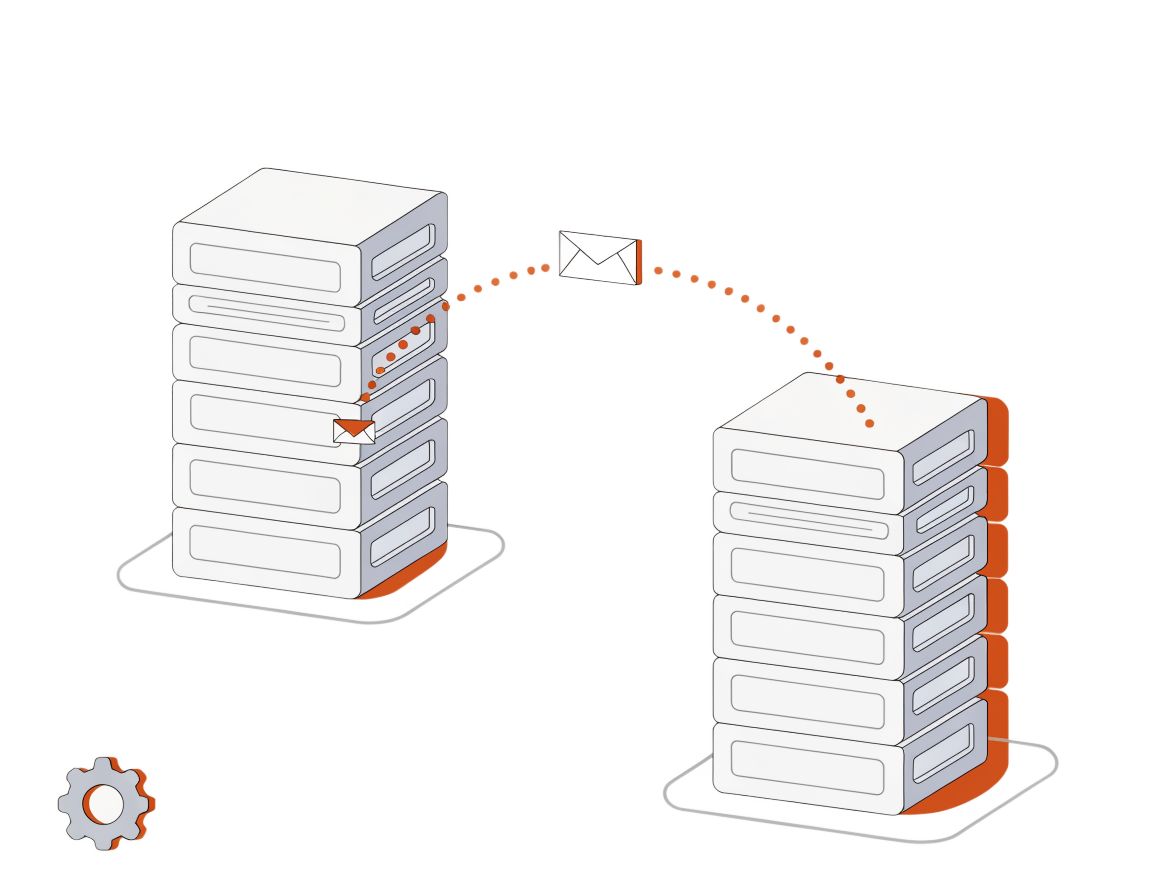
Hosted Checkout — registration and multi-year prepay
For a new registration or a multi-year prepay, send the customer to a Paymos-hosted page. They pay from their wallet and return with the domain booked. No card form on your domain and no 3DS to fight on an international audience — a clean fit for first-time buyers who don't have a card that clears with you.
See details
Payment Links — bulk transfers and reseller invoices
For a bulk transfer-in, a portfolio renewal, or a reseller settling a batch, generate a payment link from your dashboard or CRM and send it over. They pay from a wallet and your receivable clears on confirmation — useful for larger one-off amounts that want a real invoice attached.
See detailsRegistrar billing flows on stablecoins today
What renewal patterns run cleanly on a wallet?
Four flows from real registrar setups — single renewal, multi-year prepay, international ccTLD, and reseller batch.
Single .com renewal — invoice from the renewal engine
A standard yearly .com renewal: your engine issues the invoice and the customer pays it from their wallet. No fixed-fee floor eating a cheap renewal, no dead card on file triggering a failed charge — the registration extends the moment the payment confirms, and the customer keeps a domain they wanted to keep.
Multi-year prepay — Hosted Checkout
A customer prepays several years to lock pricing and avoid annual renewals. They pay once from their wallet via Hosted Checkout and the registration extends for the full term. No card to expire across those years, no annual failed-renewal risk — one payment, multiple years secured.
International ccTLD — direct wallet payment
A buyer abroad wants a ccTLD their card won't pay for with your merchant account. They pay from a wallet instead, the payment confirms in seconds, and the domain books — a registration you'd otherwise have lost to a decline, with no manual workaround on either side.
Reseller batch renewal — Payment Link
A reseller renews a batch of domains on behalf of their own customers. You send a payment link for the total, they pay from a wallet, and the receivable closes on confirmation. The whole batch settles in one transfer instead of dozens of card charges each carrying a fixed fee.
Domain registrars on stablecoins
Frequently asked questions
How does Paymos fit our existing renewal and failed-payment logic?
Renewals are recurring — does the customer have to pay manually each year?
What about ICANN fees and the registry-registrar settlement leg?
How do refunds work for a cancelled or grace-period registration?
Which networks and stablecoins should I offer for cheap renewals?
Can I keep cards for domestic customers and use Paymos only where they fail?
Honest disqualifier
When NOT to use Paymos for registrar billing
Four cases where the card stack still serves registrants better.
Auto-renew is the safety net your registrants bought
A lapsed domain can be sniped, and many registrants treat card auto-renew as insurance against exactly that. A wallet renewal needs the owner's approval every cycle — nothing can be charged without them. Keep card-on-file as the default protection layer and position the wallet for declines, dead cards, and buyers abroad.
Your registrants are all local and their cards rarely fail
The math here turns on cross-border declines, currency-conversion markup, and renewals dying on expired cards. A registrar with a domestic book and healthy approval rates sees little of that, while a second rail still adds settings, support articles, and reconciliation. Add stablecoins when international demand justifies the surface area.
Cold traffic needs the card's dispute badge to trust you
A $9 domain from an unfamiliar registrar is exactly the purchase where a buyer leans on "my card can reverse this." Stablecoin payments are final on confirmation and offer no such comfort. If your funnel converts first-time visitors, keep cards in front and let the wallet serve repeat customers and portfolio holders.
Registry bills come in fiat and you can't cash out yet
The registry leg — what you owe per domain — still gets paid from your bank account, while Paymos settles customer renewals as stablecoins to your Paymos balance. Without an exchange route between the two, revenue piles up on one side and obligations on the other. Close that loop first; the rail only works properly once it exists.
Related flows
Other Services & Hosting sub-niches on Paymos
Pricing
1.0% per settled renewal. No fixed fee, no currency-conversion markup
There is no fixed leg here to add, so a $9 renewal and a multi-year portfolio prepay cost the same share of each. Nor is the margin clipped on its way to the registry: no percentage rides on a withdrawal, and its network fee is subsidised and disclosed before the send. 0.3% is the lower rate, granted on how many renewals run and what the book totals — ask from the first one. A flat per-charge fee is what makes a cheap domain expensive: on a $9 .com the card stack works out near 6% once it lands.
See pricing